
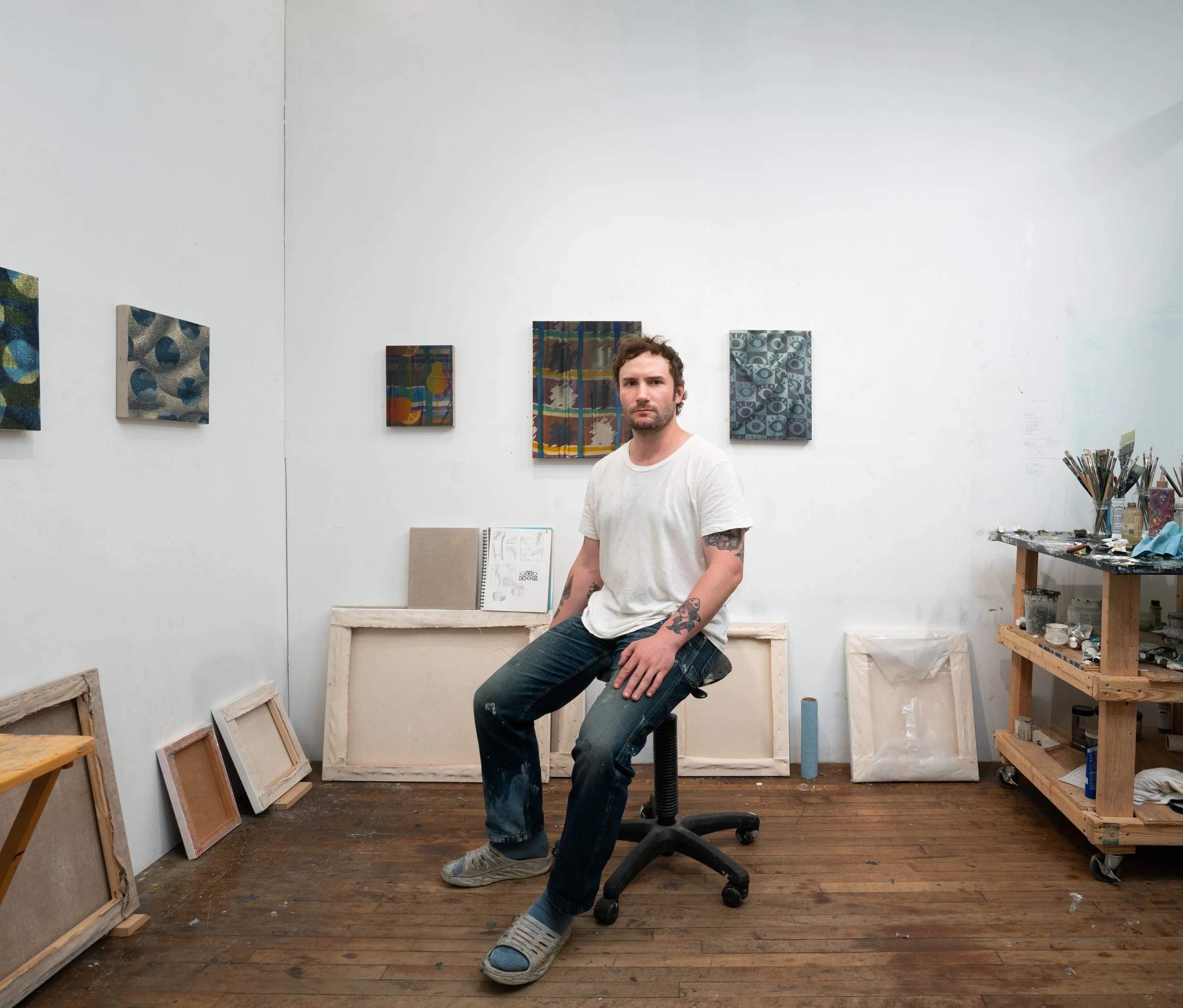
Five on the First
July 2026
Davis Arney
“My work is driven by my wonder in the tension between the material specificity of oil paint—its seductiveness, opacity, and historical burden—and the systems of illusion and mediation it enables. I approach the plasticity of the medium as both resource and constraint, using it to negotiate questions of artifice, attention, and belief. Within individual paintings, I contrast moments of uncanniness with gestures that insist on their own constructedness. These collisions produce images that hover between recognition and estrangement, activating painting as a site where perceptual certainty is both promised and undermined. The legacies of still life and trompe l’oeil function not as stylistic inheritances, but as early technologies of perceptual capture through which contemporary modes of display, consumption, and persuasion can be critically reframed.
The images I construct draw from stock photography, advertising, personal photographs, and invention, forming a hybrid archive shaped by circulation rather than origin. This compositional strategy destabilizes expressive authorship in favor of a more distributed visual logic, one that mirrors the flattened hierarchies and ambient saturation of late-capitalist image culture. I frequently subject imagery to mediating structures—mapping fabricated patterns onto bodily forms or embedding graphic motifs within architectural surfaces—to interrupt seamless illusion and foreground the conditions of visibility itself. The resulting paintings operate as synthetic environments in which fiction and fact collapse into one another, echoing the affectively neutral, sanitized aesthetics of digital space while remaining tethered to the embodied labor of painting.
My sustained engagement with textiles and design objects foregrounds painting’s historical entanglement with decoration, taste, and cultural legitimacy. These motifs operate simultaneously as vehicles for formal exploration and as critical signifiers, implicating painting in economies of desire that it has historically sought to disavow. As the son of an architect, I absorbed an attentiveness to spatial organization, aesthetic systems, and design logic; values that now function as both inheritance and object of critique. By following intuitive decisions around color, pattern, and composition, I examine how taste is conditioned, reproduced, and aestheticized within a globalized, algorithmically regulated visual culture, and consider what forms of agency, resistance, or authenticity might still be articulated within it.”
Grass Swirl, Oil on canvas, 12 × 12 inches (2026)
Concrete Crevice, Oil on canvas, 12 × 12 inches (2026)
A Comet Pulled From Orbit, Oil on canvas, 11 × 16 inches (2026)
At Heaven’s Gate, Oil on canvas, 7.5 × 11.5 inches (2026)
Candle Fence/Burning Bright, Oil on canvas, 11.5 × 20 inches (2026)